Beyond the Barbell: Why Resistance Bands Are About to Become Your New Best Friend
Let's be real for a second. When you think of resistance bands, you probably picture that dusty loop of rubber hiding in the corner of your gym, the one people use for physical therapy or—let's be honest—stretching they really don't want to do.
But here's the thing: resistance bands have secretly been leveling up, and they're ready to crash the Olympic weightlifting party. Whether you're chasing a new PR or nursing a cranky shoulder that's been giving you side-eye, bands might just be the missing piece in your training puzzle. Let's geek out on why.
The Cool Science Stuff (Made Simple)
Okay, so here's the nerdy part that actually matters. When you lift a barbell, the weight is the same at the bottom of a squat as it is at the top. That's great, but here's the catch: you're only as strong as your weakest point in the lift.
That means you're basically leaving gains on the table at the top of your movements where you're actually stronger. Enter resistance bands. As you stretch them, the tension increases. Translation? They load you up exactly where you're strongest and back off where you're weakest.
The research nerds over at the Journal of Strength and Conditioning crunched the numbers and found that this whole "variable resistance" thing can significantly boost your power output compared to just using plates. Multiple studies are backing this up—bands can help you build muscle and strength faster than going barbell-only.
How Bands Make You a Better Weightlifter
You'll Get Explosive (Like, Actually Explosive)
In Olympic lifting, slow and steady does NOT win the race. The clean, jerk, and snatch are all about speed, baby. This is where bands earn their keep.
When you slap bands on a barbell, your body has to accelerate harder to push through that increasing tension. Think of it as your own personal coach yelling at you to move faster. A study on competitive female weightlifters found that adding relatively light bands to clean pulls bumped up both power and velocity compared to using the bar alone. More power + more speed = more happy lifting.
They Match Your Body's Natural Mojo
That glorious moment in a clean or snatch when the bar just explodes upward? That's called the second pull, and it's where PRs are born. Bands actually match the force curve of this movement—meaning they ramp up tension right when your muscles are screaming "LET'S GO!" It's like your body and the band are having a conversation, and the topic is "maximum output."
In fact, some strength coaches are now using reverse band techniques on Olympic lifts to overload the catch position with weights 10-20% heavier than a lifter's 1RM . This creates an incredible stimulus for the upper back, traps, and shoulders while actually being easier on the lower back . Your body gets to feel what supramaximal weights are like without destroying your spine in the process.
They're Basically a Movement Coach
Here's a mind-blowing trick: bands can actually fix your form automatically. It's called reactive neuromuscular facilitation (RNT), which sounds fancy but works like this—if your knees cave in during a squat, put a band around them. The band will try to pull your knees further into that bad position, and your brain will freak out and yell at your glutes to shove those knees back out. Instant correction without a coach yelling at you. Magic.
3 Simple Band Exercises to Build Weightlifting-Specific Muscle
Alright, enough theory—let's get to the good stuff. Here are three band exercises that target the exact muscles you need for bigger cleans, snatches, and jerks. No fancy equipment required, just a Revision Resistance Bands Set and some sweat.
1. Banded Good Mornings (for That Posterior Chain)
Why it matters: The snatch and clean are basically posterior chain parties. Your hamstrings, glutes, and lower back do the heavy lifting in the first pull, and if they're weak, your pulls will be sad.
How to do it:
Stand on the center of a medium-band from your Revision Resistance Bands Set with your feet hip-width apart
Loop the other end around your neck (yes, really—it's cozy, we promise)
Keep a proud chest and a slight bend in your knees
Hinge at your hips like you're closing a car door with your butt
Feel that stretch in your hamstrings, then explode back up by squeezing your glutes
Sets and reps: 3 sets of 10-12. Focus on feeling those hamstrings scream... I mean, work.
2. Banded Face Pulls (for Healthy Shoulders That Actually Jerk)
Why it matters: Jerks are brutal on the shoulders, and rotator cuff issues are basically an Olympic lifter's nemesis. Face pulls build the external rotation strength and upper back stability that keep your shoulders happy when heavy weight is overhead.
How to do it:
Anchor a light band from your Revision Resistance Bands Set at face height (or loop it around a squat rack upright)
Grab the band with both hands, palms facing down
Take a step back to create tension
Pull the band toward your face, leading with your knuckles
Squeeze your upper back at the end like you're showing off your traps
Control it back slowly—no flinging allowed
Sets and reps: 3 sets of 15-20. Your shoulders will thank you tomorrow.
3. Banded Monster Walks (for Glutes That Actually Fire)
Why it matters: Weak glutes = unstable squats = knees that cave = sad weightlifter. Strong glutes keep your knees tracking properly in the squat and give you more power in the pull. Plus, they make your squat shorts look better. Win-win.
How to do it:
Place a light band from your Revision Resistance Bands Set around your legs, just above your knees
Get into a quarter squat position (athletic stance, chest up, weight on heels)
Take small, controlled steps to the side—like you're a zombie who's also really into lateral movement
Keep constant tension on the band; don't let it go slack
Go 10 steps one direction, then 10 steps back
Sets and reps: 3 sets of 10 steps each direction. Your glutes will be on fire, and your squats will instantly feel more stable.
Pro tip: Do these as part of your warm-up before squatting. You'll actually feel your glutes working during your lifts instead of wondering if they're even awake.
Why You Need the Revision Resistance Bands Set
Look, not all bands are created equal. You want bands that can handle the abuse of heavy weightlifting without snapping mid-snatch and rearranging your dental work. That's where Revision Barbells comes in.
The Revision Resistance Bands Set is specifically designed for serious lifters who demand quality and durability. Here's why they're perfect for Olympic weightlifting training:
Color-coded resistance levels that actually make sense—no guesswork, just grab and go
Heavy-duty construction that stands up to intense training sessions
Multiple resistance options from light (15-35 lbs) for activation work to heavy (50-125 lbs) for accommodating resistance on main lifts
Perfect for all three exercises we just covered—from Monster Walks to Banded Good Mornings
Whether you're looking to add accommodating resistance to your cleans and snatches, speed up your recovery from a nagging injury, or just wake up sleepy glutes before heavy squats, the Revision Resistance Bands Set has you covered.
How to Actually Use These Things
Warm-Ups That Don't Suck
Before you go attacking heavy cleans, your body needs a heads-up. A quick band circuit—like the Monster Walks and Face Pulls we just covered, plus some banded good mornings—takes less than five minutes but makes your heavy lifts feel dramatically smoother. Athletes consistently report that their joints feel more "alive" and that the bar just moves better after band activation.
Adding Bands to Your Main Lifts (Carefully)
If you're looking to smash through a plateau, bands can help. The research suggests that relatively light tension (around 10% of your bar weight) is the sweet spot for boosting power and speed. Go heavier and you might actually slow yourself down, which defeats the whole point.
For the adventurous lifters out there, you can even experiment with reverse band setups on cleans and snatches. By attaching bands from the top of a power rack to the barbell, you can deload the bottom position and overload the catch . This allows you to handle supramaximal loads in the catch position—great for building upper body strength and teaching your nervous system that heavy weights aren't scary .
Some ground rules:
Start embarrassingly light (seriously, lighter than you think)
Focus on speed—if you're grinding, the bands are too heavy
Save band work for days when your technique is on point
Try band rotations in 4-6 week chunks
Coming Back from Injury (The Smart Way)
For the walking wounded, bands let you progress loading in a controlled way. A typical comeback trail might look like:
Just holding band tension at different angles
Slow, controlled movements with light bands from your Revision Resistance Bands Set (hello, banded good mornings)
Full range of motion with progressive band tension
Mixing bands with light barbell work
Gradual return to normal training with band activation as a warm-up staple
Mobility That Doesn't Feel Like Chores
Here's a sneaky trick: anchor a band and use it to create joint distraction—basically a gentle pull that creates space in the joint. This is absolute gold for weightlifters whose hips, shoulders, or ankles have decided that full snatch depth is optional.
Picking Your Bands (Yes, You Need More Than One)
If you're going to do this, do it right. A proper band setup for Olympic lifting should include several resistances, and the Revision Resistance Bands Set delivers exactly that:
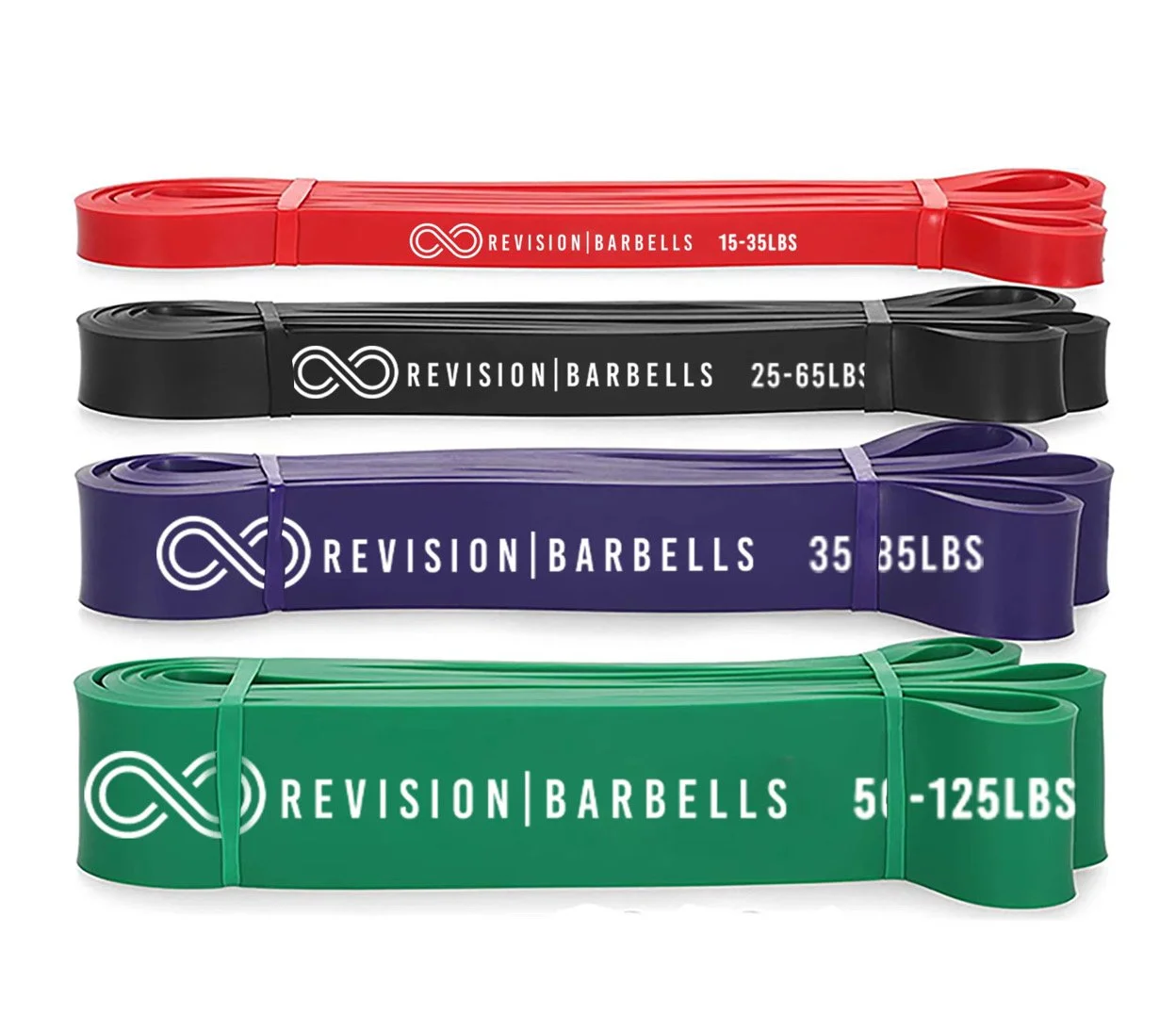
Light bands (15-35 lbs): For activation, mobility, and light banded work (perfect for those Face Pulls and Monster Walks)
Medium bands (25-65 lbs): For adding resistance to main lifts and serious assistance work (ideal for Banded Good Mornings)
Heavy bands (50-125 lbs): For when you're ready to get real weird with accommodating resistance and reverse band techniques
If you're looking for quality bands that won't snap and hit you in the face (always a plus), Revision Barbells has a solid lineup with a color-coded system that actually makes sense. No PhD required to figure out which band does what.
The Bottom Line (No Boring Conclusions Here)
Look, resistance bands aren't just for rehab patients and people who watched too many yoga videos in 2020. They're legit training tools with legit research behind them. Bands can boost your power, save your joints, fix your form, and get you back in the game faster when things go wrong.
For competitive lifters, they're a way to train explosive qualities without completely trashing your nervous system. For the rehab crowd, they're a path back to heavy lifting that keeps you strong while you heal. And for everyone else? They're just plain fun to use.
Bands look simple, but don't let that fool you. These loops of rubber are some of the most researched, versatile, and downright useful tools in the fitness world. Whether you're chasing a total or just trying to feel better in your training, bands deserve a spot in your gym bag.
Ready to take your Olympic weightlifting to the next level? Grab the Revision Resistance Bands Set today and feel the difference quality bands can make in your training, recovery, and results.